


Surprising fact: analysts estimate the resort pulls in roughly $21 million per day using attendance share, while other tallies land near $12 million.
I don’t have official park-level statements from Disney, so I’ll lay out two common estimates and show the steps behind each. One method applies an attendance share to Disney Parks’ FY2024 totals to get daily revenue and operating income. The other sums ticket sales, food, retail, parking, hotels, and add-ons using typical per-visitor spend.
In this piece I treat the Disneyland Resort as the unit of analysis — two parks plus hotels — since most totals cover resort-wide activity. I’ll break down the main income streams and explain why guests, attendance, and per-capita spend drive the numbers.
Key Takeaways
- Disney does not publish park-level figures; estimates vary by method.
- Two headline estimates: about $12M per day and roughly $21M per day.
- Attendance share applied to Disney Parks totals yields the higher estimate.
- Main revenue streams: tickets, food, merchandise, hotels, and add-ons.
- Daily averages smooth holiday spikes and weekday lulls.
Quick Answer: Disneyland’s Daily Revenue at a Glance
I’ll start with the headline averages so you can see the top-line revenue and income figures quickly.
Headline numbers: Using an attendance-share approach, my 2024 estimate is about $20.93M revenue per day and roughly $5.70M in operating income per day.
Past performance shows steady recovery: 2022 was ~$17.21M revenue/day with ~$4.47M income/day, and 2023 rose to around ~$19.95M revenue/day and ~$5.49M income/day.
Why some sources cite ~$12M versus ~ $21M
The lower ~$12M/day estimate comes from bottom-up math: conservative attendance, typical per-guest spend on tickets, food, merchandise, hotels, parking, and add-ons.
The higher figure uses a top-down method: apply the resort’s ~22.37% attendance share to Disney Parks FY totals, then divide by 365. Scope matters—estimates that include hotels and packages run higher than gate-only counts.
- Annual averages smooth peaks; holidays and events push daily totals above the mean.
- Key factors affecting these numbers include pricing, new experiences, and seasonality.
I’ll walk through the math next so you can judge which inputs feel most reasonable.
how much money does disneyland make a day
I explain the inputs I used to turn annual totals into a daily estimate.
I build my daily figures by blending Disney Parks’ FY revenue and operating income with an attendance-based slice for the disneyland resort.
Industry attendance estimates place Anaheim at roughly 22.37% of global Disney Parks visits — about 29M visitors of ~130M in 2024. That share lets me apportion corporate totals to this park and then convert annual sums into per-day averages.
What I used to estimate Disneyland Resort’s daily figures
- I start with Disney Parks’ reported FY revenue and operating income.
- I apply the ~22.37% attendance share to attribute totals to the resort.
- I convert annual totals to per-day numbers, smoothing for peaks and lows.
Attendance share and per-capita spending as core drivers
To sanity-check the top-down math, I cross-check against typical spending by category: admissions, food and merchandise, and resorts. Per visitor averages reveal how ticket pricing and add-ons shift the per person result.
“Attendance and per-person spending are the two biggest levers that shape daily revenue.”
Limits: Disney doesn’t publish park-level P&Ls, so these are informed estimates rather than official figures.
Methodology: How I Estimated Disneyland’s Daily Numbers
I use reported Disney Parks totals and an attendance slice to create an average per-day view.
I begin with Disney Parks FY2024 results: revenue ~$34.15B and operating income ~$9.15B.
Next I apply the resort’s approximate attendance share of 22.37% (about 29M visitors of ~130M). That yields roughly $7.64B revenue and $2.05B operating income attributable to the resort for the year.
Translating annual totals into per-day estimates
I divide the resort-level totals by 365 to get an average. The result is about $20.93M revenue per day and roughly $5.70M operating income per day.
Key steps I followed
- I start with Parks full-year revenue and operating income as the baseline.
- I allocate a share to the resort using its ~22.37% attendance slice.
- I convert annual figures to per day averages for an apples-to-apples comparison.
Limits and caveats
Disney does not publish Anaheim park-level P&Ls, so this allocation is an assumption-based proxy.
I exclude corporate eliminations and intercompany allocations and will cover costs (expenses) later to explain the gap between top-line revenue and reported operating income.
| Metric | Annual (Resort) | Average per day |
|---|---|---|
| Revenue (allocated) | $7.64B | $20.93M |
| Operating income (allocated) | $2.05B | $5.70M |
| Attendance (approx.) | ~29M visitors | ~79,452 visitors |
“Using attendance to allocate corporate totals is imperfect but practical given disclosure limits.”
Disneyland Resort in Context: Disneyland Park vs. Disney California Adventure

Two parks share services and guests, so park-level flows matter when estimating visitors and spend.
I clarify that the resort includes Disneyland Park and Disney California Adventure, plus three onsite hotels: Disneyland Hotel, Disney’s Grand Californian Hotel & Spa, and Pixar Place Hotel.
Two parks, shared hotels, and integrated experiences
Shared infrastructure, park-hopping, and bundled packages link both parks economically. Guests often split time between parks, which raises spend per guest across food, retail, and rooms.
How park mix and capacity shape “visitors per day”
Capacity limits, attraction lineups, and reservation rules determine how many visitors each park can host. Popular attractions or seasonal overlays push crowds toward one park.
- Attendance shifts with new rides, festivals, and holiday overlays.
- Park-hopping rules and reservations smooth or concentrate guest flow.
- Hotels and dining at the Grand Californian feed into longer park visits and higher per-guest spend.
“Visitors per day is fluid—events, marketing, and operations all change where guests go.”
| Component | Role | Impact on visitors per day |
|---|---|---|
| Disneyland Park | Mainland classic park | Attracts high baseline attendance; boosts daytime spending |
| Disney California Adventure | Seasonal events and newer attractions | Drives peaks during overlays and festival seasons |
| Onsite Hotels | Room nights and dining | Extend stays and increase in-resort spending |
Ticket Sales: The Backbone of Daily Revenue
Ticketing decisions — from date-based fares to bundled upgrades — set the financial baseline for the resort.
I track ticket sales as the clearest daily revenue driver. Single-day, single-park tickets typically range from about $104 to $179 depending on date, with Park Hopper upgrades adding a meaningful premium.
Dynamic pricing, Park Hopper, and per person averages
Dynamic pricing lets the resort lift prices on busy dates and offer lower rates on slow ones. That moves per-visitor averages without changing capacity.
Park Hopper upgrades and multi-day purchases raise the average spend. Families buying bundles or upgrades push per person totals up.
Peak days, attendance caps, and yield management
On peak days, tickets alone can exceed $10M when parks near capacity. Reservation systems and caps protect the experience and justify higher rates.
Magic Key passes and the impact on per-day income
The Magic Key program smooths demand by using blockouts and reservations. That reduces some single-day ticket revenue but stabilizes income across the calendar.
- Ticket sales are usually the largest single stream on any given day.
- Price tiers and visitor mix explain much of the swing between the ~$12M and ~$21M daily estimates.
“Ticket strategy shapes almost every revenue outcome inside the resort.”
Food & Beverage and Merchandise: Additive Spending that Scales

Beyond admissions, what guests eat and buy often nudges the daily total substantially higher.
From snacks to sit-down meals: quick items like a $5.75 churro or premium character dining at $50+ per person add layers to per person averages. Families frequently budget an extra $200–$300 for food, which multiplies across thousands of visitors.
Merch mix and limited drops
Merchandise staples—$30 ears, $50 hoodies, toys—drive steady purchases. Limited editions and exclusive drops spike impulse buys and lift overall sales.
Seasonal boosts and operations
Events like Halloween overlays and holiday offerings push higher check sizes. Festival booths and extended hours raise throughput, while mobile ordering and contactless pay increase transaction volume.
“Menu curation and exclusive items often yield higher margins than base admissions.”
- Typical per person ranges for food and beverage vary widely by format.
- Merchandise and F&B scale with attendance, compounding revenue on peak days.
- These streams can swing daily estimates more than ticket-only assumptions.
Hotels and Packages: Extending Revenue Beyond the Gates
Rooms and packages are a quiet engine that nudges daily sales well above gate-only math.
I track three onsite properties that matter most: Disneyland Hotel, Disney’s Grand Californian Hotel & Spa, and Pixar Place Hotel.
Nightly rates commonly range from about $400–$800, and occupancy runs high. Bundled packages that pair room nights with tickets, dining, or perks drive higher spend per visiting party.
Occupancy, rates, and guest behavior
- Onsite convenience and early-entry perks justify premium rates and longer stays.
- When hotels fill, more guests buy food and merchandise the next day in the park.
- Event weekends and conferences create sharp hotel-driven revenue spikes.
“Including hotel receipts shifts the average well above park-only estimates.”
| Hotel | Typical ADR | Primary impact |
|---|---|---|
| Disneyland Hotel | $400–$700 | Premium theming; higher F&B spend |
| Grand Californian | $500–$800 | Luxury rooms; longer stays and dining sales |
| Pixar Place Hotel | $350–$650 | Family focus; boosts room packages and merchandise |
Channel mix matters. Direct bookings often yield higher realized revenue than third-party bookings. Renovations and rebrands, like the Pixar Place refresh, support rate growth and stronger future sales.
Reservation lead times smooth demand across the calendar. For context on hotel revenue trends at major resorts, I link to an industry piece on hotel earnings for comparison: hotel revenue in major resorts.
Bottom line: Including onsite hotel income is a key reason a resort-level average sits near $21M rather than lower park-only figures.
Add-Ons and Premium Experiences: Lightning Lane, VIP, and More

New pass options turn wait-time avoidance into a measurable daily income stream.
Lightning Lane Multi and Single Pass
I track the Lightning Lane Multi and Single pass as direct replacements for Genie+. These options let guests buy faster entry for select attractions, turning saved time into revenue.
The pricing varies by date and demand, and uptake rates shape daily totals. Bundles that pair priority access with tickets raise the average basket size.
VIP tours, photo packages, and special events
VIP tours and PhotoPass packages sell at premium rates. They attract smaller volumes but lift single-day income significantly on busy dates.
Ticketed after-hours events and seasonal parties add distinct receipts that sit on top of normal operations.
- Lightning Lane monetizes time savings and boosts per-guest spend.
- VIP tours add high-margin revenue despite limited capacity.
- Photo packages and digital media scale with attendance.
- Seasonal events create isolated revenue spikes.
- Attractions with long lines benefit most from expedited access.
| Product | Typical Price | Primary Impact |
|---|---|---|
| Lightning Lane Multi/Single pass | $15–$60+ | Increases per-guest spend; reduces wait times |
| VIP tours | $400–$1,500+ | High-margin revenue; limited volume |
| PhotoPass & media | $30–$200 | Durable add-on; scales with guests |
| After-hours events | $80–$250 | Distinct ticket revenue; seasonal peaks |
“Add-ons and curated experiences change the revenue curve by turning time and exclusivity into sellable value.”
Costs Matter: Daily Operating Expenses vs. Operating Income
Daily revenue can look large, but costs and accounting items explain why reported income is much smaller.
Major operating categories I track
I allocate Disney Parks FY2024 cost lines to the resort using the ~22.37% share. That gives useful context for profitability.
- Staffing, maintenance, utilities, and entertainment drive ongoing expenses.
- SG&A includes corporate overhead, marketing, and support functions.
- Depreciation & amortization reflect capital intensity and long-lived assets.
Why income trails revenue
Applying the attendance share produces resort-level annual portions of roughly $3.77B (operating expenses), $1.15B (SG&A), and $0.68B (D&A). Those items explain why ~$20.93M in revenue per day yields about ~$5.70M in operating income.
| Cost bucket | Annual (approx.) | Average per day |
|---|---|---|
| Operating expenses | $3.77B | $10.33M |
| SG&A | $1.15B | $3.15M |
| Depreciation & amortization | $0.68B | $1.86M |
Bottom line: show quality, maintenance, and wage changes shape margins. Ignoring these costs can overstate what the resort actually earns on any given day.
Year-Over-Year Snapshot: 2022 to 2024
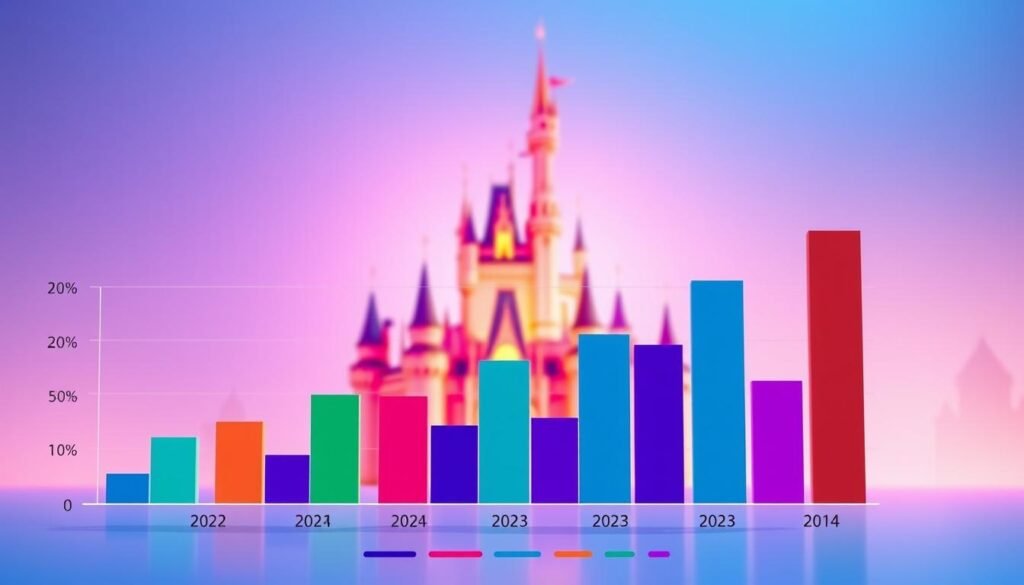
Comparing 2022 through 2024 makes the revenue and income trend clear at a glance.
Three-year view: I present daily averages from the attendance-share method to show steady growth in both revenue and operating income. These numbers give scale—millions per day—and help track margin trends.
2022
Revenue: ~$17.21M per day. Operating income: ~$4.47M per day.
2023
Revenue: ~$19.95M per day. Operating income: ~$5.49M per day.
2024
Revenue: ~$20.93M per day. Operating income: ~$5.70M per day.
I attribute this climb to stronger attendance, higher per-guest spending, and pricing optimization. New attractions, premium products, and resort investments also pushed numbers higher.
- Inflation raised costs but supported higher prices.
- Post-pandemic normalization improved visitor patterns and hotel stays.
- These are averages; peak days can outperform the mean significantly.
| Year | Revenue (per day) | Operating income (per day) |
|---|---|---|
| 2022 | $17.21M | $4.47M |
| 2023 | $19.95M | $5.49M |
| 2024 | $20.93M | $5.70M |
“Year-over-year gains reflect attendance recovery, pricing, and resort investments.”
Seasonality and Factors That Move the Daily Number
Seasonal shifts and operational choices change averages more than many data points show.
Attendance patterns drive the biggest swings. Summer, major holidays, and school breaks bring large crowds and higher per-guest receipts.
Holidays, school breaks, and attendance peaks
Peak seasons—summer, Halloween overlays, and the winter holidays—lift both visitors and per-person spending.
Event ticketing and themed merchandise boost receipts on those dates. That creates clear spikes compared with typical weekdays.
Pricing updates, new attractions, and guest spending trends
When the resort resets prices or opens marquee attractions, short-term demand often rises.
That demand raises average check sizes for tickets, hotels, and add-ons, moving the mean upward over time.
- Holidays and school breaks reliably create attendance spikes and bigger sales.
- Seasonal overlays and event tickets add revenue above base admissions.
- Price updates across tickets, hotels, food, and add-ons ratchet daily averages higher.
- New attractions and entertainment debuts catalyze short-term surges in visitors and spending.
- Weather and shorter operating hours can reduce throughput and in-park consumption.
- Local tourism patterns shape weekday versus weekend performance.
- Marketing pushes and limited offers concentrate demand into specific days.
- Inflation and product mix shifts influence guest spending behavior.
- Seasonality explains why any single-day observation differs from the annual average.
“Peak calendars and fresh offerings are the clearest reasons per-day totals diverge from yearly means.”
| Driver | Typical effect | Why it matters |
|---|---|---|
| Peak seasons | Higher attendance and check sizes | Boosts revenue per visit |
| New attractions | Short-term visitation surge | Raises both tickets and add-on sales |
| Pricing updates | Higher realized rates | Shifts daily averages upward |
| Weather & hours | Variable throughput | Alters in-park spending patterns |
Conclusion
In closing, my model frames the resort’s daily scale using attendance, pricing, and per-guest spend.
Summary: on average in 2024 the Disneyland Resort generated roughly $20.93M in revenue per day, with about $5.70M in operating income after expenses.
I acknowledge alternative tallies near ~$12M per day; those apply narrower scopes or more conservative visitor and spend inputs. Attendance, pricing, and guest behavior are the key levers that move the total.
These are estimates because Disney does not publish Anaheim park-level financials. Including hotels and add-on sales is essential to see the full picture of what the park can earn.
I encourage readers to reuse the method here as new data appears. Behind every number are the experiences that keep visitors returning to this leading theme park destination.
FAQ
What is the best quick summary of Disneyland Resort’s daily revenue?
I estimate the resort brought in roughly –21 million in total revenue per day in 2024, with operating income closer to .7 million daily. Those figures combine gate receipts, food and merchandise, hotels and add-ons, then spread annual reported totals over 365 days.
Where do the M and M per‑day numbers come from?
Different sources use different scopes. The lower figure often isolates just ticket sales or excludes hotels and international resort contributions. The higher figure uses Disney Parks consolidated results and applies Anaheim’s share of attendance to get a full-resort revenue estimate.
What data did you use to build these estimates?
I relied on Disney Parks FY2022–FY2024 reported revenue and operating income, published attendance shares for Anaheim versus global parks, per‑capita spending trends, and known hotel occupancy and average daily rates for Disneyland Resort.
How does attendance share affect the numbers?
I applied an attendance share for Anaheim (about 22.4% of Disney Parks total) to park-level revenue and income figures. That share scales Disney Parks totals down to an Anaheim estimate before converting annual totals to daily averages.
How did you convert annual figures into per‑day values?
I divided annual revenue and operating income by 365. For seasonality checks I compared peak vs. off‑peak patterns, but the headline daily numbers use a straight annual average for simplicity and comparability.
What are the limitations of this method?
Disney does not publish a standalone Anaheim P&L, so any park-level daily figure requires apportioning consolidated results. That introduces uncertainty around exactly how much hotels, licensing, and cross‑resort costs influence the split.
How do Disneyland Park and Disney California Adventure split revenue?
The two parks share guests, hotels, and retail locations. I treat them as a combined resort when estimating daily totals because gate mix, single-day tickets and Park Hopper usage blur pure park-level revenue separation.
How does park mix and capacity change daily visitor counts?
Ride capacity, seasonal overlays, and attraction demand shift per‑day attendance. Peak draws and limited reservations can concentrate spending on a few high‑traffic days, lifting the average for those periods versus the annual mean.
How important are ticket sales to overall daily revenue?
Tickets form the backbone of revenue. Dynamic pricing, Park Hopper choices, and multi‑day tickets significantly influence per‑guest spend and yield management, which in turn drive the resort’s daily totals.
How do peak days and caps affect daily income?
Capacity caps and sold‑out days raise per‑guest yields because demand allows higher prices and more add‑on purchases. Off‑peak days lower the average, which is why a straight annual average smooths those swings.
What role do Magic Key passes and annual passes play?
Annual pass programs and Magic Key-style plans change visit frequency and spending patterns. They lock in revenue upfront but can reduce single-day ticket receipts; however, passholders often spend on food and merchandise during repeat visits.
How much do food and merchandise add to the daily total?
Food & beverage and retail typically add a substantial share of per‑guest spending. Items from snacks to character dining and limited‑edition merchandise scale with attendance and special events, boosting daily revenue beyond gate receipts.
Do seasonal events increase in‑park sales?
Yes. Halloween, holiday overlays, and festivals drive higher per‑person spend through themed food, exclusive merchandise, and ticketed experiences, lifting average daily revenue during those runs.
How do hotels and packages contribute to the resort’s daily revenue?
The Disneyland Hotel, Grand Californian, and Pixar Place Hotel add room revenue and bundled packages. Occupancy rates and average nightly rates translate into sizable daily contributions separate from park gates.
How do add‑ons like Lightning Lane and VIP tours affect totals?
Paid queue access, private tours, and photo packages increase per‑guest revenue significantly. These premium experiences are high‑margin items that raise operating income even if they serve a smaller guest subset.
What are the main daily operating expenses that reduce income?
Labor, maintenance, utilities, SG&A, and depreciation are large daily costs. Those expenses explain why operating income is materially lower than gross revenue despite strong top‑line figures.
Why is operating income smaller than overall revenue?
High fixed and variable costs—staff, upkeep, entertainment production—consume a big portion of revenue. After those costs and corporate allocations, operating income represents the resort’s true daily profit contribution.
What were the year‑by‑year daily averages from 2022–2024?
My estimated averages: 2022 about .2M revenue/day with .47M income/day; 2023 roughly .95M revenue/day and .49M income/day; 2024 around .93M revenue/day and .70M income/day.
How significant is seasonality on daily estimates?
Seasonality is major. Holidays, school breaks, ride openings and promotions create large day‑to‑day variance. The annual average smooths this but planners should expect sizable peaks and troughs throughout the year.