

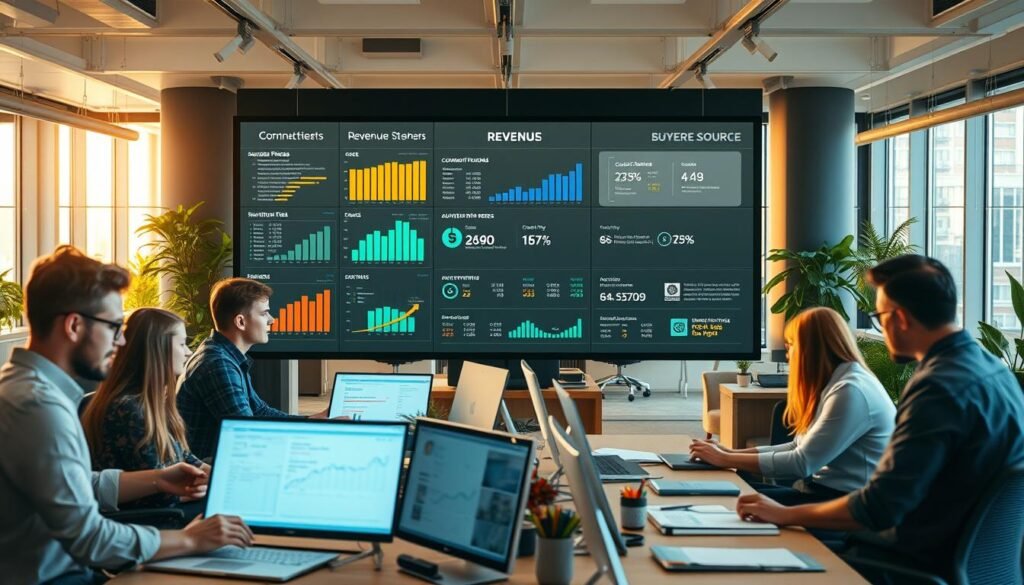
Surprising stat: the service says 30 million people save over $2 billion each year through offers at gas stations, restaurants, and grocery stores.
I’ll walk you through the business model and the growth of the upside app in a clear, buyer‑guide style. I cover what the platform does for users and merchants, how partners share revenue, and where the company earns revenue.
Quick preview: Upside works at 50,000+ U.S. locations, partners with brands like Shell, BP, Exxon, and gives real cashback — up to 25¢/gal at pumps and strong restaurant and grocery offers in select metros.
Users claim offers, verify purchases, and withdraw funds to bank, PayPal, or e‑gift cards. The platform charges merchants only when verified transactions prove incremental value, using test‑vs‑control analytics to align results with payouts.
Key Takeaways
- Upside is a performance‑first cashback platform active in gas, food, and groceries.
- The upside app connects users to offers and verifies purchases for payouts.
- Partners pay when the platform shows incremental customer lift.
- Recognizable brands and 50,000+ locations give wide market reach.
- Users can cash out via bank, PayPal, or gift cards.
Why I Wrote This Buyer’s Guide on Upside’s Business Model
I wrote this buyer’s guide to give a practical, wallet‑focused view of the upside app and its commercial logic.
I want readers — both shoppers and merchants — to get clear answers fast. I value transparent, performance‑driven models in a crowded market. Cashback platforms are surging and partnerships like Ibotta‑Walmart show why this space matters now.
My goal: show whether the app fits your wallet or your growth plan as a business partner. I tested product mechanics in the app and checked public numbers like funding and valuation.
“A pay‑for‑incrementality pitch lowers upfront risk for merchants and focuses payouts on real customer lift.”
I set clear criteria to judge strengths and limits: regional availability, offer density, and user experience frictions. I also note the role of app development choices — card‑linking, check‑in, and receipt verification — in building trust and scale.
- I explain my evaluation method.
- I separate hype from proof using observable analytics.
- Use this guide as a checklist for similar platforms and mobile app choices.
The Short Answer: how does upside make money
I cut straight to the point: the app earns when verified purchases trigger partner payouts.
What Upside earns when you earn
Your cash back comes from a profit‑share arrangement. Partners fund the incentive and pay a commission when the platform proves the sale was incremental. That commission covers your payout and the app’s fee.
Why partners pay only for incremental value
The platform uses test‑versus‑control comparisons to show lift. By comparing cohorts, Upside proves which transactions are additive. Brands then pay only for measurable gains, shifting upfront risk away from businesses.
- Primary revenue streams: affiliate‑style commissions tied to verified purchases.
- Secondary streams: white‑label/API licensing and anonymized analytics sold to partners.
- Personalization: ML tailors offers to boost conversion, raising partner ROI and the app’s commissions.
“Pay‑for‑incrementality aligns incentives: users get real cashback, businesses pay for proven lift, and the platform earns a slice of partner revenue.”
I’ll break down category payouts and examples in later sections so merchants can estimate margin impact.
What Upside Is and Where I Can Use It Today
Here’s a clear snapshot of where the app works and the savings to expect. I tested coverage across common spend categories and tracked where offers concentrate.
Gas stations, restaurants, and grocery stores at scale
In plain English: the upside app is a free, nationwide cashback tool you open before filling up, dining out, or shopping groceries.
The core categories are clear: gas stations, restaurants, and grocery stores. Gas offers reach major chains like Shell, Exxon, BP, Mobil, and Circle K.
Real-world reach: 50,000+ locations across the United States
The platform covers more than 50,000 locations nationwide: 25,000+ gas stations and 17,000+ restaurants. Select metros — Minneapolis, St. Louis, Los Angeles, Chicago, Phoenix, Raleigh — host grocery deals.
- Savings ranges: up to 25¢/gal at the pump, up to 45% at restaurants, and up to 30% at participating groceries.
- Brands you’ll see: Shell, Valero, BP, Phillips 66, Circle K, Speedway, 76, Racetrac, Conoco, Mobil, Exxon.
- Tip: grocery coverage varies by metro, so check the app’s local deal density before relying on it.
Offers and locations update regularly. Granting location permissions improves discovery and helps the map view surface net prices after cashback.
Expectation: your individual savings depend on where you live and how often you spend on gas and food. I suggest checking the map in the app before you head out.
My Step-by-Step Look at How Upside Works for Users

I describe a realistic user flow to highlight where the app saves time and cash.
Finding and claiming offers in the app
I open the app, grant location access, and scan the map for nearby deals. Gas prices show after discounts so I can compare net cost before I drive.
Tip: claim offers right before purchase—the app often limits windows on claimed rewards.
Card linking, check-in, and receipt verification
I add a debit credit card in “my wallet” to speed verification. Linked cards let the platform match card transactions without a photo receipt.
Sometimes the app asks for a receipt. Clear photos prevent delays and speed reward posting.
Cash-out options: bank, PayPal, and e-gift cards
Rewards usually post in 2–4 business days, though it can take up to a week. I cash out after reaching the $10 minimum via bank transfer, PayPal, or e-gift cards.
Pro tip: enable notifications and location settings to catch time-sensitive offers at the pump.
“Frequent use builds a richer offer history, which can surface better-targeted rewards over time.”
- I scan the map and compare net gas and dining prices before I go.
- I claim offers close to my purchase time and check the station brand and address match.
- Card transactions plus occasional receipt uploads let the app verify purchases reliably.
| Step | What I do | Timing |
|---|---|---|
| Download & signup | Create account, link card | 5–10 minutes |
| Find & claim | Use map, claim before purchase | Immediate |
| Verify purchase | Card match or receipt photo | 2–7 business days |
| Cash out | Bank, PayPal, e-gift cards (min $10) | Varies by payout method |
For a quick read on app basics and recent coverage, see this short piece at what to know about the upside.
Upside’s Core Revenue Stream: Partner Commissions and Profit Sharing
I break down the core loop below so the revenue picture is easy to follow.
The main engine is a commission paid after the app verifies a purchase and proves it was incremental for the partner.
Affiliate-style commissions tied to verified purchases
The platform functions like an affiliate network. Merchants pay a referral fee when the app drives new or larger transactions. Verified purchases via card-linking, check-in, or receipts reduce fraud and speed payouts.
Category-based rates: pizza to grocery baskets
Rates vary by category and partner. For example, a pizza order may carry ~4.5% commission while a grocery basket can near ~9%. Each merchant negotiates terms to protect margin and tune offer size.
Test-versus-control to prove incremental sales
Upside shows uplift with matched test-versus-control cohorts. By comparing similar shoppers, the platform quantifies incremental sales so businesses pay only for true lift.
“Users get cash; partners see incremental revenue; the platform collects a commission — all tied to verified purchases.”
- Why partners accept this: it shifts spend from fixed marketing cost to performance-based payouts.
- Margin discipline: merchants can cap offers and focus on profitable transactions.
- Resilience: revenue scales with actual purchases, not impressions, which protects the model over time.
Beyond Commissions: White-Label and API Licensing
Embedding reward rails inside other apps boosts reach without extra user friction. I examined the partner tooling and found two clear lines of revenue: licensing fees and referral payouts. These options let the company tap partner audiences while merchants still pay per verified transaction when appropriate.
Embedding in partner apps
I saw integrations in apps like Uber, Lyft, GasBuddy, and Current. In practice, a user stays inside their favorite app and sees local offers, claims rewards, and verifies purchases without switching contexts.
What partners get
- Faster time to market because partner APIs and white‑label components remove heavy app development work.
- Higher session time and monthly retention when rewards live in the native experience.
- Shared referral revenue from transactions that start inside the partner environment.
Why this adds recurring value
Licensing fees give steady platform revenue beyond single commissions. Referral income flows when partner users complete purchases initiated inside partner apps. Over time, these streams compound as more apps embed the service.
“Embedding rewards in partner experiences reduces churn and spreads acquisition cost across established audiences.”
| Integration Type | Example Partner | Primary Benefit |
|---|---|---|
| White‑label | Current | Native UX, low build time |
| API | GasBuddy | Fast offer delivery, receipt matching |
| SDK/embed | Uber | Increased sessions, referral revenue |
| Deep link/referral | Lyft | Simple activation, measurable conversions |
Bottom line: embedding the app in partner experiences is a diversification play. It complements core performance commissions and scales reach through existing customer bases.
Data and Insights: How Anonymized Analytics Drive B2B Revenue
Here I unpack the ways aggregate transaction trends become a sellable product for partners.
Privacy-first analytics: the company states it never sells personal profiles. Instead, it packages anonymized, aggregated statistics that comply with GDPR notions of non-personal outputs.
Why businesses pay: retailers and chains want category lift, regional demand shifts, and competitive positioning. Those signals help tune offer size, timing, and placement to boost ROI.
What partners receive
- Aggregate trends by category and region that reveal where spend is growing.
- Dashboards and custom reports for campaign optimization and budgeting.
- Cross-category signals from gas, grocery, and dining to spot changing consumer behavior.
Revenue impact: selling access to these insights creates a recurring B2B line for the platform. It complements commission fees and licensing and reduces cyclicality.
“Aggregate intelligence improves targeting and raises partner ROI without exposing individual users.”
When evaluating the service, I advise businesses to ask about reporting granularity and refresh cadence so the market signals match their planning cycle.
Personalization Engine: Machine Learning That Lifts Conversion
My focus here is the personalization layer that lifts conversion and shapes which offers users see.
What the model uses: location signals, debit credit histories, and in‑app behavior feed a machine learning system. It ranks available rewards so the app shows offers I’m most likely to accept.
The engine learns from credit card transactions and receipt matches to spot patterns. Cross‑category signals — for example, grocery plus fuel habits — let the model suggest timely deals near commute routes.
Why this matters to users and partners
Users get fewer irrelevant alerts and more practical savings. Partners see higher acceptance rates, more transactions, and larger commission pools because targeted offers convert better.
- Smarter ranking raises conversion and transaction volume.
- Continuous training adapts to seasonal changes and user actions.
- Personalization creates retention and a performance moat versus new entrants.
Practical note: businesses should ask about A/B tests and dashboards that show lift from personalized campaigns. That transparency links data in to measurable revenue out.
“Targeted rewards mean better ROI per impression and a stickier program for everyone.”
| Signal | Example Use | Benefit |
|---|---|---|
| Location | Show gas offers near commute | Higher timely redemptions |
| Card-linked history | Suggest grocery combos after past purchases | Improved relevance, more transactions |
| Behavioral data | Promote cuisine types a user prefers | Higher offer acceptance |
What This Means for Users, Merchants, and the Platform
Let me spell out the practical payoff for shoppers, businesses, and the app.
Users get clear value: cash back and targeted rewards that post reliably, plus simple cash‑out options. App store ratings (~4.8 on App Store, ~4.7 on Google Play) back user satisfaction and fast reward delivery.
Businesses gain measurable incremental sales because the platform pays only for verified lift. Performance fees reduce risk compared with fixed ad buys and can free up budget in tight market conditions.
The platform earns commissions, licensing, and analytics revenue. That diversification lowers reliance on any single category and deepens partner relationships over time.
“Proof‑of‑incrementality builds trust and fosters long‑term partnerships.”
- Verification (card link, check‑in, receipts) keeps payouts accurate.
- Repeated use compounds benefits: more usage yields better offers via personalization.
- Merchants should consider API or white‑label integration to meet customers where they already spend time.
Bottom line: the model aligns incentives — users save, businesses gain customers, and the platform collects revenue only when both sides win.
Market Snapshot in the United States Right Now
Here’s a compact snapshot of the U.S. market and the company’s recent milestones.
Valuation, funding, and scale milestones
Headline numbers: the company has raised about $265M and sits near a $1.5B valuation. Reported annual revenue is roughly $128M.
Footprint: the platform covers 50,000+ locations, including 25,000+ gas stations and 17,000+ restaurants, with grocery stores present in select metros.
Why cashback apps are surging across categories
Macro drivers: inflation sensitivity and smartphone‑led discovery push users toward cost-saving tools. Partnerships like Ibotta‑Walmart show category momentum for rewards tied to everyday spend.
Gas and grocery stores act as anchor verticals because they drive repeat habits and steady volume. That makes recurring transactions valuable for both the app and merchant partners.
Competitive note: competition is rising, so personalization and partner economics will decide who gains long‑term market share. Local availability still varies, so interpret these numbers against your region.
“Reliable verification and consistent payouts are key to sustaining user growth and partner trust.”
In my view, watch for more embedded rewards inside third‑party apps as APIs and white‑label deals expand the market and deepen reach for the upside platform.
Strengths I See in Upside’s Model
After testing the product and partner stack, I’m impressed by a few clear advantages that keep this platform practical for both merchants and regular shoppers.
No upfront merchant cost, performance-first economics
The no‑upfront‑fee approach lowers the barrier for merchants to trial offers. Operators pay only when the platform proves incremental sales, which de‑risks promotions for small chains and national brands alike.
This pay‑for‑performance loop builds trust with finance teams. It also forces campaign discipline: partners set caps and expect measurable lift before funds flow.
Large partner network and strong mobile UX
Network breadth matters: presence at 25,000+ gas stations and 17,000+ restaurants drives repeat behavior among users and creates steady transaction volume for partners.
The mobile app experience reinforces that habit. A clear map, after‑discount gas prices, and simple check‑in or receipt flows make redemption fast and audible to users.
- Cashback and cash-out flexibility: bank, PayPal, or e‑gift options keep rewards tangible.
- Incrementality focus: test‑versus‑control and personalization reduce wasted spend.
- Personalization as a moat: tailored offers raise conversion versus generic coupon models.
- White‑label/API reach: embedding the product in partner apps multiplies distribution and retention.
- Data as an asset: anonymized insights improve both consumer targeting and merchant planning.
“Aligning incentives — users receive real cash, partners pay for proven lift, and the app earns a share — is the core strength I see.”
Bottom line: the business model combines low entry frictions for partners, a habit‑forming mobile app for users, and data‑driven tools that sustain growth across categories like gas stations and dining.
Read a concise overview of the business for a deeper look at partner economics and verification mechanics.
Limitations and Buyer Considerations
I tested the app in multiple metros to spot practical limits you should weigh before relying on it.
Regional availability and deal density
Coverage varies by place. Not every market has deep offers, and grocery participation is metro‑specific. I advise checking local deal density inside the app before you plan trips around savings.
Some users report thin offer pools in smaller towns. If you live outside major metros, expect fewer restaurant and grocery deals compared with big cities.
Occasional pricing discrepancies at the pump
There are reports of mismatches between listed pump prices and on‑site signage. Always verify the station brand, address, and net price in the app before you fuel.
Verification friction: certain offers still require receipts, and card verification can be a hurdle for people who prefer cash at the pump.
- Check deal density in your local app view before relying on savings.
- Confirm station details and net price to avoid surprises at gas stations.
- Be ready to upload a receipt for some offers; that step delays final cash posting.
- Merchants should cap offers to protect margins in volatile gas markets.
- Data freshness varies by partner; stale feeds can misrepresent availability.
- Enable notifications selectively to catch timely deals without alert fatigue.
- Compare net prices across nearby stations even when offers look similar.
- Merchants: request transparent incrementality reporting and QA on data feeds.
“Testing in your specific market is the best way to validate value; local results drive real outcomes.”
Bottom line: the app delivers clear upside for many users, but regional gaps, occasional pump mismatches, and verification steps mean you should test it in your market before relying on it for routine savings.
What an App “Like Upside” Would Need to Compete
I’ve thought about the product and partner needs, and a competing app must combine reliable tech with demonstrable partner economics.
Must-have features
Mapping and real-time pricing: a live map with net prices after rewards is table stakes for driver and shopper trust.
Verification stack: card-linking, check-in flows, and receipt OCR cut fraud and speed payouts.
Payout reliability: fast, predictable cash-outs (bank, PayPal, e-gift) are essential to keep users engaged.
Moats that matter
Partner network: national fuel and grocery partners create repeat volume and defend distribution.
Personalization: models that use location and spend signals raise conversion and lifetime value.
Proof of incrementality: merchant dashboards with test‑versus‑control results are non-negotiable for partner buy-in.
“Without clear economics and verifiable lift, a new platform will struggle to recruit partners.”
From an app development standpoint, teams must choose between cross-platform speed and native UX depth. Both routes require strict privacy, security, and fraud prevention. Early partner APIs and white‑label options extend reach quickly, but they need reliable data pipelines and fresh price feeds to avoid stale listings.
| Requirement | Why it matters | Implementation note |
|---|---|---|
| Real-time map | Helps users compare net costs | Integrate live price feeds, cache with short TTLs |
| Verification stack | Reduces fraud, proves purchases | Card-link + OCR + check-in; automated reconciliation |
| Merchant dashboard | Shows incremental ROI | Test-vs-control reports and exportable metrics |
| Partner APIs / White-label | Scales distribution | Stable REST APIs and embeddable SDKs |
Bottom line: a competitive platform balances solid mobile app development, fast payouts, and hard proof of lift. Without those three pillars, partners and users will choose established options.
If I Were Evaluating Upside for My Wallet or Business
I run a simple, one-month experiment to see real value. I track claimed offers, log net prices, and tally posted rewards until I hit the $10 cash threshold to withdraw. That shows whether the app helps me save money in everyday driving and dining patterns.
How I’d test user savings and retention
I keep a short ledger: date, location, claimed offer, net price, and post date for the cash. I note if I open the app weekly and whether offers match my routes and cuisine.
- Timing: check posting times and receipt delays.
- Retention: track weekly opens and repeat redemptions.
- Verification: confirm purchases post and allow for occasional receipt photos.
How a retailer would validate ROI and margin impact
I’d run a pilot with clear KPIs: incremental transactions, basket lift, and contribution after payout. Insist on test‑versus‑control reporting and transparent data cadence.
- Calibrate offer sizes to protect margin before scaling.
- Monitor fraud controls, verification friction, and customer service load.
- Consider API or white‑label embedding if you already have an app audience to keep customers in flow.
“Pilot with tight KPIs and you’ll see whether revenue lifts cover payouts and operational cost.”
Conclusion
In short: the platform earns when it proves partners gained customers, and users receive real cashback in the process.
I summarize the three revenue pillars: performance commissions, white‑label/API licensing, and anonymized analytics. These streams, plus personalization and robust verification, keep the model resilient.
Practical notes: regional gaps and occasional pump price mismatches matter. I suggest a 30‑day user test to confirm savings and a pilot for retailers with margin‑aware offers and clear incrementality reporting.
At scale—$265M raised, near a $1.5B valuation, ~50,000 locations—the company shows product‑market fit. If you’re building an app like upside, focus on mapping, verification, fast payouts, and proof of incremental lift.
Takeaway: when value aligns for users, partners, and the platform, everyone wins.
FAQ
How does Upside generate revenue from partner merchants?
I explain that Upside earns partner commissions tied to verified purchases. Merchants pay only when the app drives incremental sales, so Upside gets an affiliate-style fee or profit share after a purchase is confirmed via card link or receipt verification.
What kinds of merchants work with Upside?
I note that Upside focuses on gas stations, restaurants, and grocery stores at scale, plus convenience stores and some retail chains. The platform targets high-frequency spend categories where cashback can change customer choice.
Why do partners prefer paying only for incremental value?
I describe that paying only for incremental sales lowers risk for merchants. They avoid upfront marketing spend and only compensate Upside when the app demonstrably brings new or incremental spend, proven through test-versus-control methodologies.
How do users redeem offers and get paid?
I walk through claiming offers in the app, linking a debit or credit card, checking in or uploading a receipt when required, and then cashing out via bank transfer, PayPal, or e-gift cards depending on available payout options.
What verification methods confirm a purchase?
I outline card transaction matching and receipt verification as the two main methods. Card linking allows automatic matching of spend, while receipt uploads or photo capture provide proof when card-level linking isn’t available.
Does Upside sell personal user data to advertisers?
I clarify that Upside generates B2B revenue from aggregated, anonymized analytics and market intelligence rather than selling personally identifiable information. Data is typically processed under privacy and regulatory standards to protect users.
What is Upside’s white-label or API licensing model?
I explain that Upside licenses its cashback engine and embeds offers in partner apps—examples include integrations with GasBuddy or ride-share platforms. Partners may pay licensing fees, share referral revenue, or use a revenue-share arrangement.
How does machine learning improve the platform’s performance?
I state that a personalization engine uses location, card transactions, and behavioral signals to optimize offers. ML boosts conversion and increases the value merchants are willing to pay by targeting likely buyers and fine-tuning rewards.
What fee structures should I expect across categories?
I mention that commission rates vary by category—gas, pizza, groceries—based on margins and expected incremental lift. Categories with tight margins typically see lower cashback rates than higher-margin items like dining.
How does Upside prove incrementality to partners?
I describe test-versus-control experiments and A/B tests that compare customer behavior with and without offers. These approaches let merchants see real lift in incremental transactions attributable to the app.
Can merchants embed Upside offers into their own apps?
I confirm that Upside offers white-label solutions and APIs so retailers or platforms can integrate cashback functionality directly, gaining referral revenue and recurring value from improved customer retention.
What are the main benefits for users?
I highlight that users get cash-back rewards on everyday purchases, savings at participating gas stations and grocery stores, and simple payouts. The app can reduce out-of-pocket costs without changing shopping habits.
What limitations should I consider before using the app?
I point out regional availability and deal density as common limits—some areas have fewer offers. Also, occasional pricing discrepancies at the pump or merchant checkout can affect the expected net savings.
How large is Upside’s real-world reach in the U.S.?
I state that Upside partners span tens of thousands of locations nationwide, including 50,000+ participating spots in many markets, giving broad coverage for gas, food, and groceries.
What competitive moats would an app like Upside need?
I say a competitive product needs mapping, reliable receipt or transaction verification, timely payouts, a large partner network, personalization, and robust proof of incrementality to win merchant trust.
How should a retailer validate ROI from partnering with a cashback platform?
I recommend retailers run pilot tests, measure incremental sales against control groups, track customer retention lift, and compare commission expense to margin improvement from new or higher-value purchases.
Are there other revenue streams beyond commissions?
I note additional streams such as licensing fees for white-label solutions, referral revenue from integrations, and value-added analytics products sold as aggregated business intelligence to partners.
How does Upside protect user privacy while offering analytics?
I explain that Upside typically uses aggregated, non-personal data and follows privacy best practices and applicable regulations, anonymizing transaction signals before delivering insights to merchants.
Why are cashback apps growing across categories?
I point to shifting consumer price sensitivity, mobile-first behaviors, and merchant demand for measurable, performance-based marketing. These forces make cashback platforms an attractive channel for both shoppers and brands.
What should I test if I evaluate this platform for personal use?
I suggest testing typical spending categories in your area, linking a single payment card for a short trial, and measuring real savings after accounting for any price differences at local merchants.