


Surprising fact: a 1904–2023 backtest shows buy-and-hold grew $100 into $62,414, far outpacing timing schemes that tried to beat the market.
I write as a U.S. investor who favors clear data and plain language. I use the classic A/B/C cycle — A for panic, B for good times, C for hard times — as a simple lens for the market today.
I will show what Robert Shiller’s long-run data and modern backtests reveal about these patterns. I also explain why rigid timing often loses to staying invested, even if some windows trimmed big losses in 1937, 2000, and 2008.
My aim is practical: I will respect time in the market, admit timing limits, and share how I adjust risk, cash flow, and opportunity without betting the farm. This guide helps people weigh risk and reward and learn how I choose actions that fit my goals.
Key Takeaways
- Buy-and-hold beat strict timing across 1904–2023, despite some useful signals.
- The A/B/C labels offer a quick frame for spotting market patterns.
- I use data, not prediction, to guide my risk and cash-flow choices.
- Short-term loss control can matter, but long-term growth usually wins.
- This guide helps investors apply a practical playbook for different periods.
Why I’m writing this Ultimate Guide for future-focused investors in the U.S.
My goal is to cut through viral noise and give U.S. investors a clear, usable playbook for the market.
I see social media flood feeds with charts and loud predictions. That chatter often ignores long-run data and the cost of chasing quick wins.You can learn more about best-way-to-make-gta-online-money
- I want a short, evidence-driven map that saves me time and helps my decisions in noisy markets.
- I will balance simple labels with testable strategies like rebalancing, position sizing, and hedging.
- I’ll show where predictions add value and where they hurt long-term results.
I aim to translate cycle labels into steps I can use today. That means clear rules, not vague slogans.
If you want a future-focused approach that respects growth and risk, this guide is built for action.
Periods when to make money: what the A, B, C years really mean
My chart of A, B, and C years helps me decide whether I hedge, harvest, or buy. I use these labels as a practical map, not crystal-ball predictions. The cycle gives a clear frame for pacing risk and action in the market.You can learn more about how-much-money-does-disneyland-make-a-day
A years: panic, trend reversals, and heightened risk
A years are high-risk windows where panic and sharp trend reversals cluster. I cut leverage, raise cash, and favor hedges. Volatility can spike; labels guide patience over guesswork.
B years: good times to sell into strength
B years feel like good times. Prices climb and breadth strengthens. I trim winners and rebalance into laggards. This lets me harvest gains while keeping exposure aligned with goals.
C years: hard times, low prices, and accumulation zones
C years are the classic accumulation zones. Sentiment is poor and bargains appear. I buy quality in tranches and reinvest dividends. Gradual buying beats exact timing.
The 16-18-20 and 8-9-10 rhythm, plus 11-9-7 bottoms
“Tops often show at roughly 16–18–20 years, mid-cycle crests at 8–9–10, and troughs near 11–9–7.”
- I use these patterns as ranges, not precise calendar bets.
- A for hedging and patience; B for harvesting; C for disciplined accumulation.
- Labels shape my pace, not my entire plan.
From Benner to Tritch: the cycle chart that keeps coming back
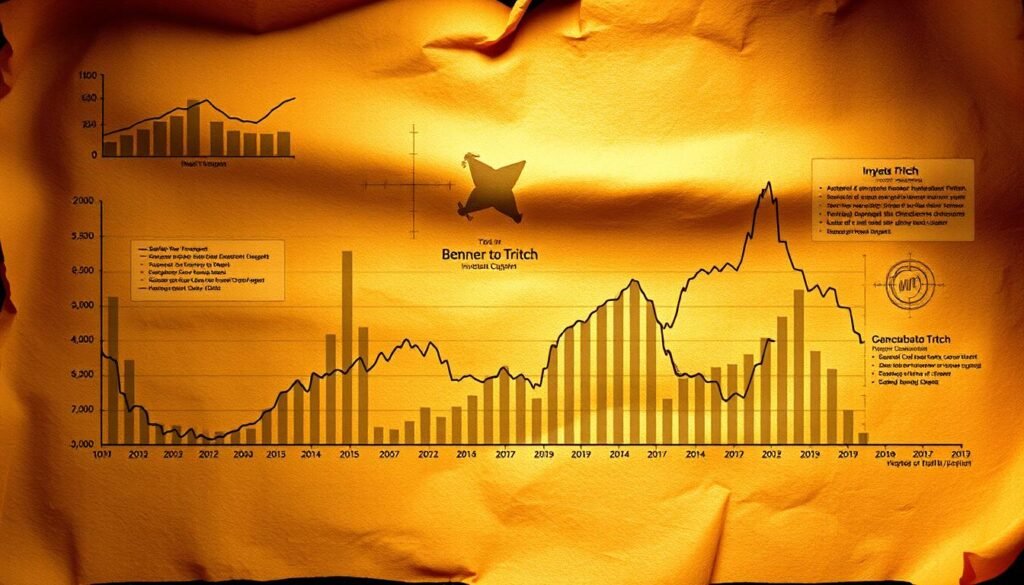
An 1875 pamphlet planted a simple rhythm into investing lore that still echoes today.
Samuel Benner was an Ohio farmer crushed by the Panic of 1873 and a hog cholera outbreak. He published Benner’s Prophecies of Future Ups and Downs in Prices, mapping pig iron, corn, and hog swings. That work treated pig iron as a bellwether and sketched the 8-9-10 peaks, 11-9-7 troughs, and the 16-18-20 panic cadence.
I note the benner prophecies future framing and the phrase future ups downs for how prices might travel. Benner used data, not magic, and his chart aimed at practical forecasts for ups downs prices in staples.You can learn more about how-to-make-a-money-as-a-teenager
Samuel Benner’s 1875 “prophecies” and the pig iron, corn, hogs cycle
Benner tied commodity swings to broader trends. His tables gave traders a way to read likely turns and plan buys and trims.
George Tritch’s leaflet and the A/B/C market labels
George Tritch distilled those ideas into a short leaflet that labeled A, B, and C years. Tritch’s version made the concept easy to remember and helped the chart cross from farms into broader market use.
The authorship debate is lively, but the legacy matters more: both Benner and Tritch fed a compact chart that investors still consult. That shared history explains why these cycles resurface in my reading of market rhythm.
Does the chart work? What 150 years of market data actually show
I tested the A/B/C framework across Shiller’s series to see what real market behavior looks like.
Short answer: the labels map useful probabilities, not certainties. The data help me set odds, risk bands, and brief plans rather than make precise predictions.
C → B: hard times turning into good times
C→B windows were positive 81.25% of the time with average gains near 32.12%.
That includes huge wins like 1996–1999 (+103.24%) and the exception during the Great Depression (1931–1935: −42.05%). These results show the classic tradeoff: steady upside, rare severe losses.
C → A: hard times that become long rallies
C→A posted an 87.5% hit rate and averaged 61.66% gains. These stretches are longer and higher variance, so patience often pays.
A → C: panic into another downturn
A→C is the weakest hit rate (37.5%) but still averaged +17.29%. Strong examples include 1945–1951 (+57.23%) and 2019–2023 (+51.9%).
- Key point: past performance is not a guarantee of future results, but the chart frames probabilities.
- I use ranges and risk bands because prices and market behavior vary across years.
| Window | Hit rate | Average gain |
|---|---|---|
| C→B | 81.25% | +32.12% |
| C→A | 87.5% | +61.66% |
| A→C | 37.5% | +17.29% |
“Data inform probabilities; they do not erase uncertainty.”
Timing the market vs. time in the market: my take using Shiller data

The data compare three timing rules against buy-and-hold and the gap surprised me.
Backtests: three strategies vs buy-and-hold
I tested three simple strategies based on Tritch’s labels across 1904–Apr 2023.
Findings: the best timing approach compounded $100 into $5,432. Buy-and-hold grew that $100 into $62,414. That is roughly a 12x performance gap.You can learn more about what-are-at-least-two-ways-credit-card-companies-make-money
| Strategy | Rule | End value | Notes |
|---|---|---|---|
| Strategy 1 | Buy in C, sell in B | $X,XXX | Often out during long advances |
| Strategy 2 | Buy in C, sell in A (long) / B (short) | $5,432 | Best among timing rules |
| Strategy 3 | Like #2 but short A→C | $X,XXX | Worst performance; costly shorting |
| Buy-and-hold | Always invested | $62,414 | Captured multi-year bull legs |
Drawdowns, opportunity cost, and my practical view
Timing trimmed big drawdowns in 1937, 2000, and 2008. But the opportunity cost was large. Sitting out long bull runs made recovery very hard.
My takeaway: I favor time in the market as my default. I use cycle cues to trim, rebalance, and hold a cash buffer. That lets my stocks stay invested but with guardrails against major risk.
How reliable is this for decisions today? Patterns, predictions, and psychology

Patterns in markets can be helpful clues, but they rarely hand me a neat plan.
Astro-economics claims add drama. Tritch linked cycles with planetary motion. That claim lacks a clear causal mechanism. Critics note modern markets shift. I treat the chart as a loose pattern, not a precision tool.
Astro-economics and causality: why precision is elusive
I accept uncertainty. Predictions hold appeal, yet they fail as firm rules. I protect my portfolio with simple risk controls and cash buffers.
Narrative fallacy, social media virality, and self-fulfilling hype
Charts spread fast on social media. Stories feel right and can change behavior. That can create self-fulfilling moves. I use labels as context, not commands.
- I watch causality: weak, so I stay disciplined.
- I focus on process over flashy predictions.
- I check bias and limit emotional trades.
| Factor | Reliability | Action |
|---|---|---|
| Causal link | Low | Use as soft signal |
| Historical fit | Moderate | Weigh with fundamentals |
| Behavioral spread | High | Guard plans from hype |
“Patterns can guide attention; discipline manages risk.”
Looking ahead: cycles, markets, and potential scenarios into the late 2020s
I treat the next decade as conditional paths, not a single forecast. That helps me plan without overcommitting to any single prediction.You can learn more about how-much-money-does-elon-musk-make-a-second
2023–2026: a bias toward good times, checked by price action
I read 2023–2026 as a “good times” window but I watch how prices behave today.
Volatility and narrow breadth can hide under a rising index. I trim winners in a calm bull market and keep some cash for dips.
2026–2032: possible panic and hard times — risks I’m watching
Key themes I monitor are rising global debt, persistent inflation, and geopolitical shocks. Each raises the odds of a deeper drawdown or even a serious financial crisis.
My plan is simple: hold core exposure, widen cash buffers, and scale hedges only if macro signals confirm stress.
Crypto cycles and halving narratives: cautious cross-market mapping
Bitcoin halving and token cycles carry strong narratives, but they do not map cleanly onto equity behavior. I treat crypto as a separate market with distinct liquidity and drivers.
“Even in ‘unfavorable’ windows, markets can rally; discipline beats panic.”
- I build scenario paths — soft landing, stagflation, rolling recessions — and set trigger rules for adjustments.
- I use price, breadth, and macro cues rather than headline predictions to shift allocations.
- Buffers and rules protect me from reacting to noise while keeping upside exposure.
My practical playbook: strategies for using cycles without betting the farm
I keep a pragmatic playbook so cycle signals inform actions without dictating them. I treat cycles as a probability layer that nudges decisions rather than a timing system that controls my portfolio.
Risk tiers: trimming in B, accumulating in C, hedging in A
I divide risk into three simple tiers. In B I trim winners and rebalance toward target weights.
In C I dollar-cost average into quality stocks and raise conviction on core assets. In A I tighten risk, add hedges, and lean on cash buffers.
Position sizing and rebalancing rules that put probabilities first
I scale position sizes by probability signals. Bigger adds occur in confirmed C uptrends; smaller trims occur in extended B rallies.
Rebalances happen on rules, not emotion: quarterly checks and set thresholds keep discipline intact.
Combining cycles with fundamentals, breadth, and macro signals
I never use cycles alone. I pair them with earnings, balance-sheet checks, advance/decline breadth, and credit metrics.
That mix helps me choose which asset or factor tilt deserves capital and which needs trimming in a frothy market.
Decision checklists to reduce emotion during panic and euphoria
Prewritten rules beat panic. I keep short checklists for stress events and for rallies so my decisions follow process.
- I avoid broad shorting of the market; backtests show it drags returns, so I prefer hedges and barbell positions.
- My asset playbook centers on core index exposure, selective factor tilts, and deployable cash.
- Reviews are quarterly, not daily, with cycle context guiding modest tactical moves.
“Use cycles as context; let rules handle the work.”
Read more on timing vs time in
Conclusion
, I close with a clear rule: use the cycle as a compass, not as a clock.
I favour a process that keeps core stock exposure while pacing trims and adds by the chart and price action. That way I respect compounding and limit panic-driven errors.
I credit Samuel Benner and George Tritch for framing ups and downs, but I pair that history with rules, breadth checks, and cash buffers. Patterns guide my attention; disciplined rules protect my capital when markets surprise.
My forward stance is active monitoring: I watch prices, breadth, and macro cues, iterate the playbook, and stay ready to act with patience in hard years and humility in hot bull runs.
FAQ
What do A, B, and C years mean for investors?
I use A years to describe high‑stress periods with trend reversals and sharp volatility, B years as phases where selling into strength often pays off, and C years as low‑price windows for disciplined accumulation. These labels help me frame risk and opportunity rather than predict exact dates.
Who were Samuel Benner and George Tritch, and why do they matter?
Samuel Benner published cycle observations in 1875 tying commodity swings to repeating rhythms; George Tritch later popularized the A/B/C market labels. I study their charts because the same patterns reappear across long stretches of market history, offering a useful heuristic for modern investors.
Do cycle charts actually work over long periods?
Over 150 years the A/B/C rhythm often shows predictable transitions—C to B tends to reward investors, while A to C transitions are less reliable. I emphasize that results vary: the chart improves odds, but it isn’t a crystal ball and has notable exceptions in major crises.
Should I try to time the market using these cycles?
I don’t recommend full market timing. My backtests with Shiller data show buy‑and‑hold often outperforms poorly timed moves because missing prolonged rallies costs more than avoiding downturns. I favor tactical adjustments—trim in B, accumulate in C—rather than all‑in timing.
How do I size positions and manage risk across A, B, C labels?
I use tiered risk rules: smaller positions and hedges in A, lock in gains during B, and scale into favored assets in C. Position sizing is probability driven—set predefined cutoffs and rebalance rather than relying on emotion during panic or euphoria.
Can astro‑economic or prophecy models give precise forecasts?
No. I treat astro‑economic ideas and prophetic charts as narrative tools, not causal engines. They can highlight patterns but lack the precision required for confident timing. I combine them with fundamentals, breadth, and macro signals for better context.
How should I use this framework with crypto and other modern markets?
I’m cautious mapping old cycles directly to crypto. Digital assets have unique drivers like halvings and network effects. I apply the A/B/C mindset—reserve higher risk allocations, expect steeper swings, and avoid assuming perfect synchronicity with equity cycles.
What mistakes do investors make applying cycle ideas?
The biggest errors I see are overconfidence in precision, ignoring drawdowns from missing bulls, and chasing narratives on social media. I advise clear checklists and rules to limit emotion and prevent single‑event thinking from wrecking long‑term plans.
How far ahead can these patterns reasonably inform decisions?
I use them for multi‑year scenarios rather than day‑trading signals. Patterns can help frame 3–10 year outlooks and risk scenarios, but I won’t claim accurate timing to the month or week. I treat the chart as a compass, not a stopwatch.
Are historical results a guarantee of future returns?
Absolutely not. Past performance doesn’t guarantee future results. I rely on historical patterns to tilt probabilities and design rules, but I always stress contingency planning for unprecedented shocks and regime changes.